M6.6 earthquake near Río Grande, Panama
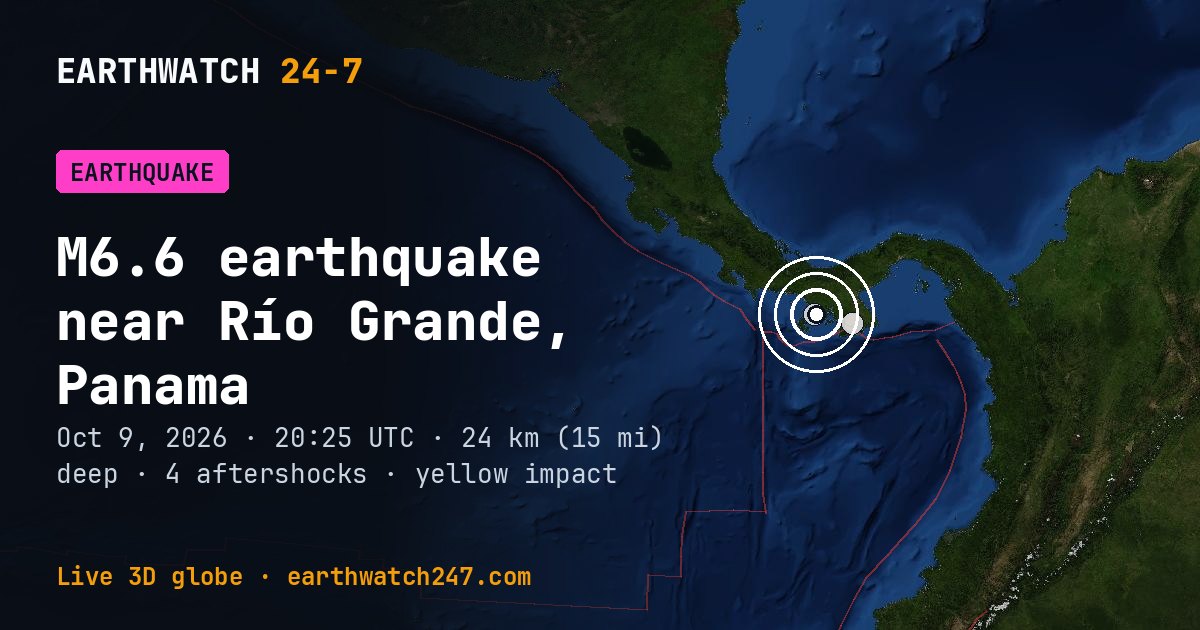
A magnitude 6.6 earthquake struck 12 km (7 mi) west of Río Grande, Panama on Friday, October 9, 2026 at 20:25 UTC, at a depth of 24 km (15 mi), according to the U.S. Geological Survey. Shallow quakes like this one shake the surface hardest. The nearest city of a million or more people is Panama City, Panama, about 253 km (157 mi) away.
USGS set its tsunami flag for this earthquake. The flag is set automatically for large earthquakes at sea and is not a warning. For official tsunami information, see tsunami.gov and your national warning center.
USGS’s PAGER impact estimate is YELLOW: some damage possible.
36 people reported feeling it to USGS “Did You Feel It?”.
Why here?
This earthquake struck about 68 km (42 mi) from the boundary between the Cocos and Nazca plates. Most earthquakes happen along plate boundaries like this one, where the pieces of Earth’s outer shell collide, pull apart or grind past each other. Stress builds up over years until the rock suddenly slips.
The red lines on the map are plate boundaries.
What kind of fault?
USGS’s analysis of the seismic waves shows it was an oblique earthquake: the fault slipped partly sideways and partly as one block pushed up over the other.
Shaking and impact
The strongest shaking USGS estimates was intensity 7 on the Modified Mercalli scale: very strong. About 450,331 people were exposed to moderate shaking or stronger (intensity 5 and up), including about 3,523 to very strong shaking or worse (7 and up). USGS’s PAGER system estimates it most likely caused no deaths (90 percent probability). Early estimates are revised as reports come in.
How strong was it?
Magnitude is logarithmic: each whole step releases about 32 times more energy. This magnitude 6.6 released roughly the energy of 120 kilotons of TNT, about 8 times the Hiroshima atomic bomb. That is about 7,900 times the energy of a magnitude 4.0, a quake people nearby feel but that rarely causes damage. The strongest earthquake ever recorded, magnitude 9.5 in Chile in 1960, released about 22,000 times more than this one.
Aftershocks
In the first 16 days after it, USGS recorded 4 smaller earthquakes of magnitude 2.5 or more within 100 km (62 mi). The largest was a magnitude 6.1 on October 12 at 23:20 UTC.
- M6.1 · 15 km W of Río Grande, PanamaOct 12 23:20 UTC
- M6.0 · 7 km N of La Tronosa, PanamaOct 10 04:14 UTC
- M4.3 · 6 km SE of Pitaloza Arriba, PanamaOct 20 22:51 UTC
- M4.0 · 2 km N of El Cortezo, PanamaOct 22 03:24 UTC
Outside the United States, USGS mainly lists quakes of about magnitude 4 and up, so smaller aftershocks there are undercounted.
Earthquake history here
Before this earthquake, USGS had recorded 109 earthquakes of magnitude 6 or larger within 300 km (186 mi) since 1900. The strongest:
- M7.7 · 12 km WSW of Pitaloza Arriba, PanamaOctober 9, 2026
- M7.6 · 34 km S of Limón, Costa RicaApril 22, 1991
- M7.5 · 44 km ESE of Burica, PanamaJuly 18, 1934
Official details, updates and the shaking map: USGS event page.
See every earthquake on October 9, 2026 or earthquakes by day.
More from around the world
- Soyuz 2.1b launch: Progress MS-36Nov 24, 2026
- Falcon 9 Block 5 launch: NROL-195Nov 5, 2026
- Falcon 9 Block 5 launch: Starlink Group 15-21Nov 5, 2026
- Asteroid 2025 UK9 flies past EarthOct 31, 2026
- GSLV Mk. II launch: IRNSS-1LOct 30, 2026
- Falcon 9 Block 5 launch: Starlink Group 15-18Oct 30, 2026
- Falcon 9 Block 5 launch: Starlink Group 15-16Oct 27, 2026
- Tornado Warning: El Paso, Texas and Hudspeth, TexasOct 26, 2026