Asteroid 2026 RO39 flew past Earth
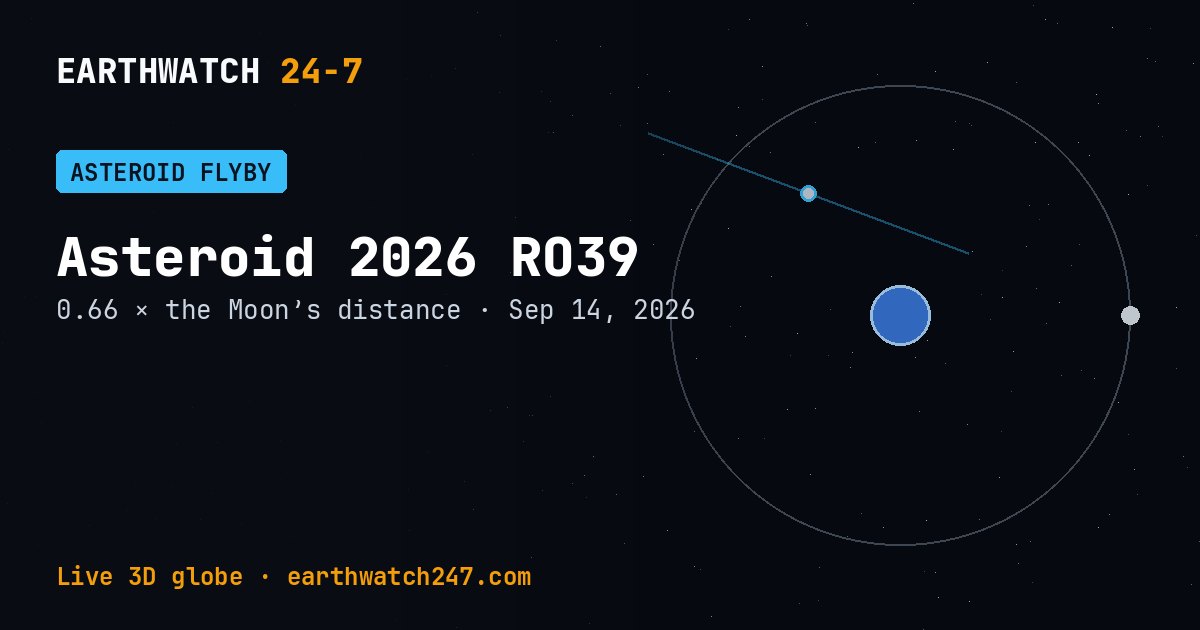
Asteroid 2026 RO39 passed Earth on Monday, September 14, 2026 at about 07:44 UTC, at 254,498 km (158,145 miles): 0.66 times the distance to the Moon, closer than the Moon itself. It was moving at 10.5 km/s (23,441 mph) relative to Earth and is about 4 to 8 meters (12 to 26 feet) across, judging by its brightness. NASA’s orbit puts it safely past: it posed no risk of hitting Earth on this pass.
Its orbit
It is an Apollo asteroid: its orbit is larger than Earth’s but crosses it. It circles the Sun once every 534 days. Astronomers first spotted it on September 15, 2026, 1 days after it passed.
How often does this happen?
Small asteroids pass between Earth and the Moon every few weeks; most are only a few meters to tens of meters across and are found days before, or even after, they fly by. For scale, the rock that exploded over Chelyabinsk, Russia, in 2013 was about 18 meters across.
Did you know?
Measuring with the Moon. Asteroid flybys are measured in lunar distances: one is the average Earth–Moon distance, about 384,400 km.
Data: NASA JPL Small-Body Database and CNEOS close approaches. Size assumes a reflectivity between 5 and 25 percent.
More: every space weather and near-Earth page · all events
More from around the world
- Asteroid 2025 UK9 flies past EarthOct 31, 2026
- Asteroid 2026 TP6 flies past EarthOct 15, 2026
- Hurricane SimonOct 14, 2026
- M4.9 earthquake near Kokopo, Papua New GuineaOct 14, 2026
- M4.7 earthquake near La Mesa, PanamaOct 14, 2026
- Asteroid 2026 TG9 flew past EarthOct 14, 2026
- M4.9 earthquake near La Tirana, ChileOct 14, 2026
- M4.8 earthquake in the North Atlantic OceanOct 14, 2026