M6.5 earthquake in the Bonin Islands, Japan region
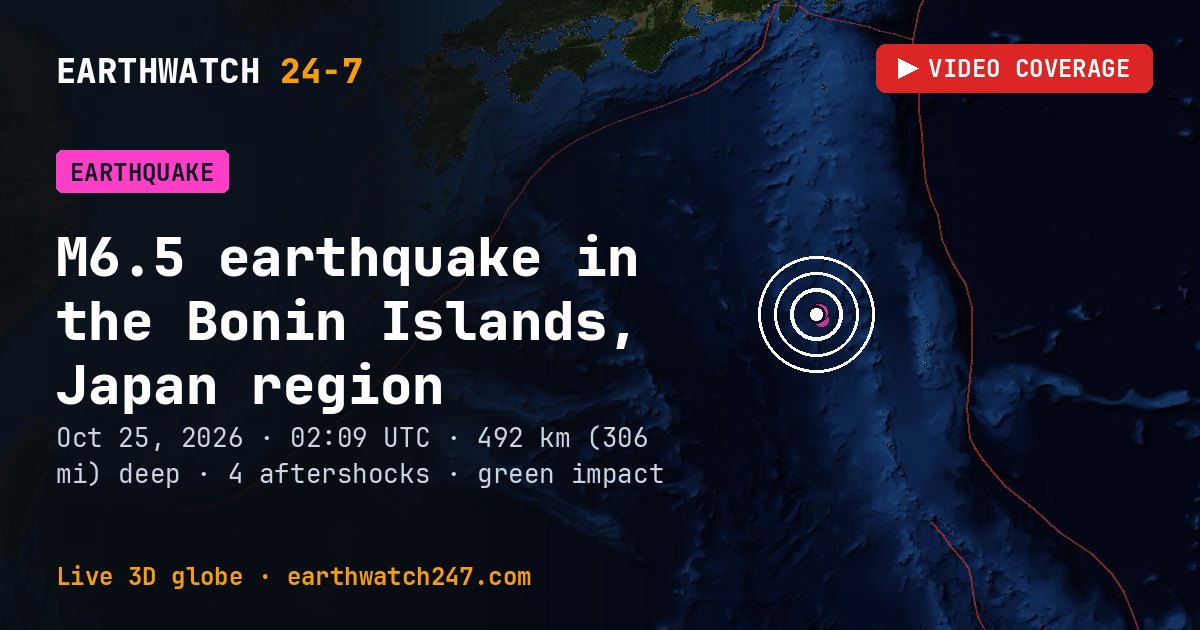
A magnitude 6.5 earthquake struck in the Bonin Islands, Japan region on Sunday, October 25, 2026 at 02:09 UTC, at a depth of 492 km (306 mi), according to the U.S. Geological Survey. Quakes this deep are usually felt widely but rarely cause damage. It struck far from land: no town on our map lies within 600 km (373 mi). The nearest city of a million or more people is Yokohama, Japan, about 849 km (528 mi) away.
USGS set its tsunami flag for this earthquake. The flag is set automatically for large earthquakes at sea and is not a warning; at this depth, a tsunami is unlikely. For official tsunami information, see tsunami.gov and your national warning center.
USGS’s PAGER impact estimate is GREEN: little or no damage expected.
Video coverage
 Breaking ShortBreaking on Earth · Oct 25: M6.5 Quake in the Bonin Islands, Japan RegionOct 25, 02:30 UTC · ▶ Watch on YouTube
 Update 1LatestM6.5 Earthquake Bonin Islands, Japan region · Update 1 · Oct 25Oct 25, 02:49 UTC · ▶ Watch on YouTube
Why here?
This earthquake struck 492 km (306 mi) down, about 341 km (212 mi) from the nearest plate boundary on the surface. Quakes this deep happen inside old ocean plate that has sunk far into the mantle at a subduction zone, long after it dove beneath its neighbor. Their great depth spreads the shaking over a wide area but usually keeps it gentle at the surface.
The red lines on the map are plate boundaries.
What kind of fault?
USGS’s analysis of the seismic waves shows it was a strike-slip earthquake: the two sides of the fault slid past each other sideways, like California’s San Andreas Fault.
Shaking and impact
USGS’s PAGER system estimates it most likely caused no deaths (90 percent probability). Early estimates are revised as reports come in.
How strong was it?
Magnitude is logarithmic: each whole step releases about 32 times more energy. This magnitude 6.5 released roughly the energy of 85 kilotons of TNT, about 5.7 times the Hiroshima atomic bomb. That is about 5,600 times the energy of a magnitude 4.0, a quake people nearby feel but that rarely causes damage. The strongest earthquake ever recorded, magnitude 9.5 in Chile in 1960, released about 32,000 times more than this one.
Aftershocks
In the first 26 hours after it, USGS recorded 4 smaller earthquakes of magnitude 2.5 or more within 100 km (62 mi). The largest was a magnitude 5.3 on October 25 at 22:14 UTC.
- M5.3 · Bonin Islands, Japan regionOct 25 22:14 UTC
- M4.8 · Bonin Islands, Japan regionOct 25 02:36 UTC
- M4.8 · Bonin Islands, Japan regionOct 25 22:16 UTC
- M4.2 · Bonin Islands, Japan regionOct 25 02:47 UTC
Outside the United States, USGS mainly lists quakes of about magnitude 4 and up, so smaller aftershocks there are undercounted.
Earthquake history here
Before this earthquake, USGS had recorded 66 earthquakes of magnitude 6 or larger within 300 km (186 mi) since 1900. The strongest:
- M7.8 · Bonin Islands, Japan regionMay 30, 2015
- M7.4 · Bonin Islands, Japan regionAugust 6, 2000
- M7.4 · Izu Islands, Japan regionMarch 6, 1984
Official details, updates and the shaking map: USGS event page.
See every earthquake on October 25, 2026 or earthquakes by day.
More from around the world
- Soyuz 2.1b launch: Progress MS-36Nov 24, 2026
- Falcon 9 Block 5 launch: NROL-195Nov 5, 2026
- Falcon 9 Block 5 launch: Starlink Group 15-21Nov 5, 2026
- Asteroid 2025 UK9 flies past EarthOct 31, 2026
- GSLV Mk. II launch: IRNSS-1LOct 30, 2026
- Falcon 9 Block 5 launch: Starlink Group 15-18Oct 30, 2026
- Falcon 9 Block 5 launch: Starlink Group 15-16Oct 27, 2026
- Tropical Storm VanceOct 26, 2026