Coronal mass ejection toward Earth, November 14, 2026
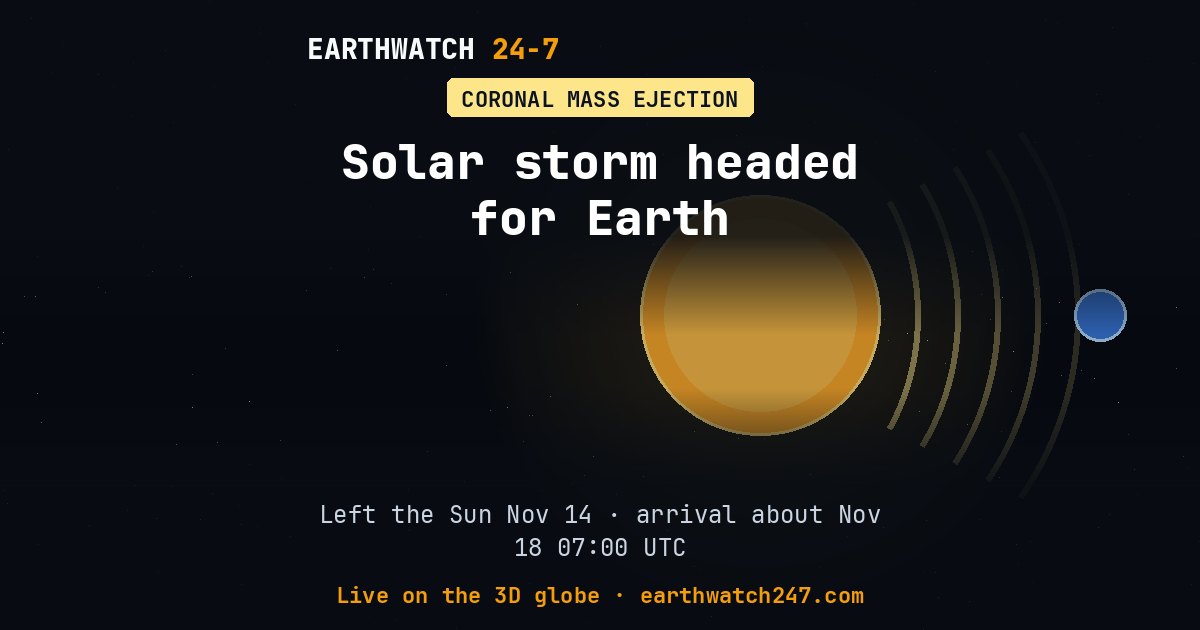
A coronal mass ejection, a billion-ton cloud of magnetized gas, left the Sun on November 14, 2026 at 22:15 UTC, moving at about 804 km/s (1,800,000 mph). NASA’s model forecast it to deliver a glancing blow to Earth around Wednesday, November 18 at 07:00 UTC, plus or minus several hours. In the model’s strongest scenario it pushes the K index to 4, below storm level.
What happens when it arrives
If the cloud’s magnetic field points south when it hits, it can couple with Earth’s and set off a geomagnetic storm: auroras far from the poles, and in strong storms trouble for power grids, satellites and GPS. Arrival times are model forecasts and are often off by six hours or more. Live outlook: aurora forecast.
Data: NASA DONKI (WSA-ENLIL model).
More: every space weather and near-Earth page · all events
More from around the world
- Coronal mass ejection toward Earth, November 19, 2026Nov 19, 2026
- Coronal mass ejection toward Earth, November 1, 2026Nov 1, 2026
- Coronal mass ejection toward Earth, October 21, 2026Oct 21, 2026
- M6.7 earthquake near Carhuamayo, PeruNov 21, 2026
- M4.9 earthquake near Pangai, TongaNov 20, 2026
- Tornado Warning: San Benito, CANov 20, 2026
- Tornado Warning: Merced, CANov 20, 2026
- Long March 6C launch: undisclosed payloadNov 21, 2026