Coronal mass ejection toward Earth, November 28, 2026
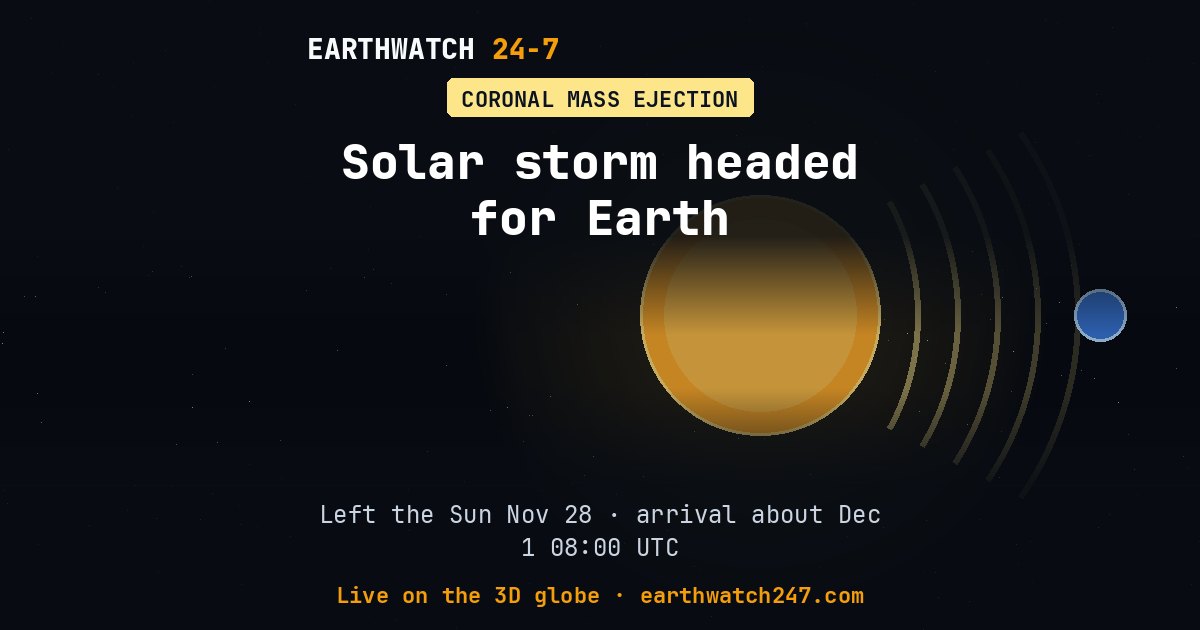
A coronal mass ejection, a billion-ton cloud of magnetized gas, left the Sun on November 28, 2026 at 07:24 UTC, moving at about 827 km/s (1,850,000 mph). NASA’s model forecast it to deliver a glancing blow to Earth around Tuesday, December 1 at 08:00 UTC, plus or minus several hours. In the model’s strongest scenario it pushes the K index to 5, a G1 geomagnetic storm.
What happens when it arrives
If the cloud’s magnetic field points south when it hits, it can couple with Earth’s and set off a geomagnetic storm: auroras far from the poles, and in strong storms trouble for power grids, satellites and GPS. Arrival times are model forecasts and are often off by six hours or more. Live outlook: aurora forecast.
Data: NASA DONKI (WSA-ENLIL model).
More: every space weather and near-Earth page · all events
More from around the world
- Coronal mass ejection toward Earth, November 25, 2026Nov 25, 2026
- Coronal mass ejection toward Earth, November 19, 2026Nov 19, 2026
- Coronal mass ejection toward Earth, November 14, 2026Nov 14, 2026
- M4.8 earthquake near Sola, VanuatuNov 28, 2026
- Dust Storm Warning: Bent, CO, Crowley, CO, El Paso, CO and 6 more areasNov 28, 2026
- M4.0 earthquake near Manhattan Beach, CANov 28, 2026
- Snow Squall Warning: Gunnison, CO and Pitkin, CONov 28, 2026
- Long March 6C launch: undisclosed payloadNov 29, 2026